


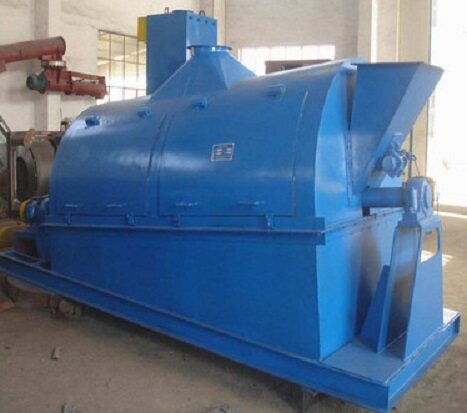

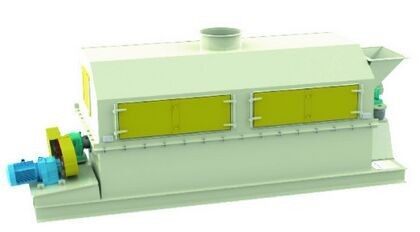
Fine hexagonal sieve
The screening flow path of the high-efficiency and fine hexagonal screen is reasonable: the large head of the hexagonal screen feeds and screens, and the small head discharges hard block waste. The old-fashioned low-efficiency multi-angle screen has an inverted screening flow path: the small head feeds and screens, and the large head discharges hard block waste.
Screening principle: The hexagonal screen cylinder is fed at the large end. The screen area is increased by 40 to 50%. A 6×26 small-aperture screen is adopted, and the screen holes still maintain a high production rate. Sand beans equal to 60% of the screen hole diameter are screened out. The rotational speed of the screen cylinder is increased to approach the theoretical speed of the ball mill. The material rushes down from the highest point of the screen cylinder. Meanwhile, the high-speed jolting and impact effect of the hexagonal screen cylinder enables the old sand lumps to achieve fine crushing and screening. Due to sand treatment, the waste products have been reduced to 1/10 to 1% of those from the old-fashioned screens. A large number of users have applied it, all achieving good technical and economic benefits, with a sand recovery rate greater than 99%. Moreover, there is no need to install crushers on the old sand production line anymore, reducing investment.
The fine hexagonal screen is made of high-strength and high-hardness cold-drawn stainless steel wire woven screen mesh. It is taut on the screen frame with a special tensioning mechanism that is easy to disassemble and assemble, and is not prone to wear and tear. In the large-scale casting production of the automotive industry, its service life has reached more than 6 years. The sieve holes are non-sticky and non-clogging, with good retention. They are suitable for fine crushing and screening of wet, hot and sticky old sand. Just ventilate moderately. Do not use the heating device of some screen machines for the screen mesh.
The length-to-diameter ratio of the screen cylinder of the fine hexagonal screen has been increased from 1.5 to 2:1 of the old-fashioned screen to 3:1. This not only facilitates fine screening but also covers a large area and a long distance for screening. Ventilation of the screen body can achieve a certain cooling effect on the hot old sand, simplify the sand processing line, and greatly save investment.
The fine hexagonal screen adopts a spatial truss type screen frame and main shaft. Rubber springs are added under the main shaft at the feeding end to absorb the vibration when the material is crushed by jolting. It is driven by an alloy steel hard-toothed surface reducer and other measures. Ensuring the reliability of the equipment guarantees its long-term operation on the assembly line, with minimal maintenance and repair work, high efficiency and stability, and small downtime losses.


