


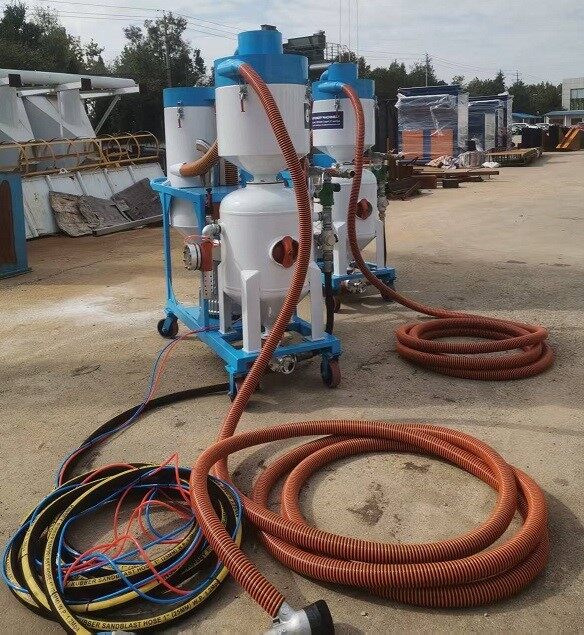
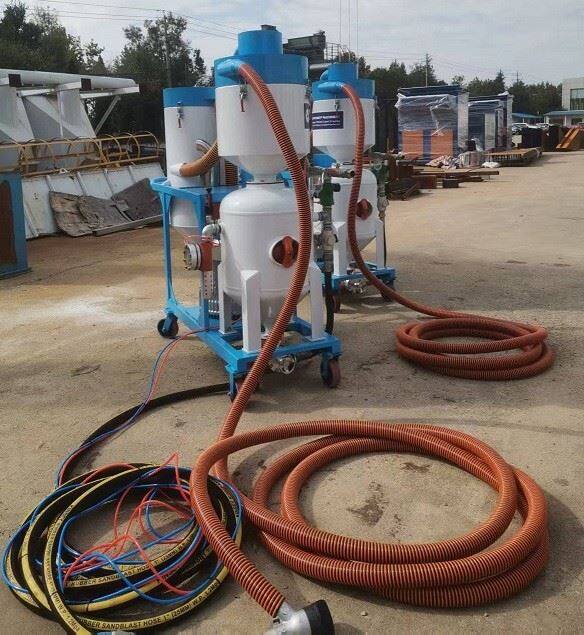
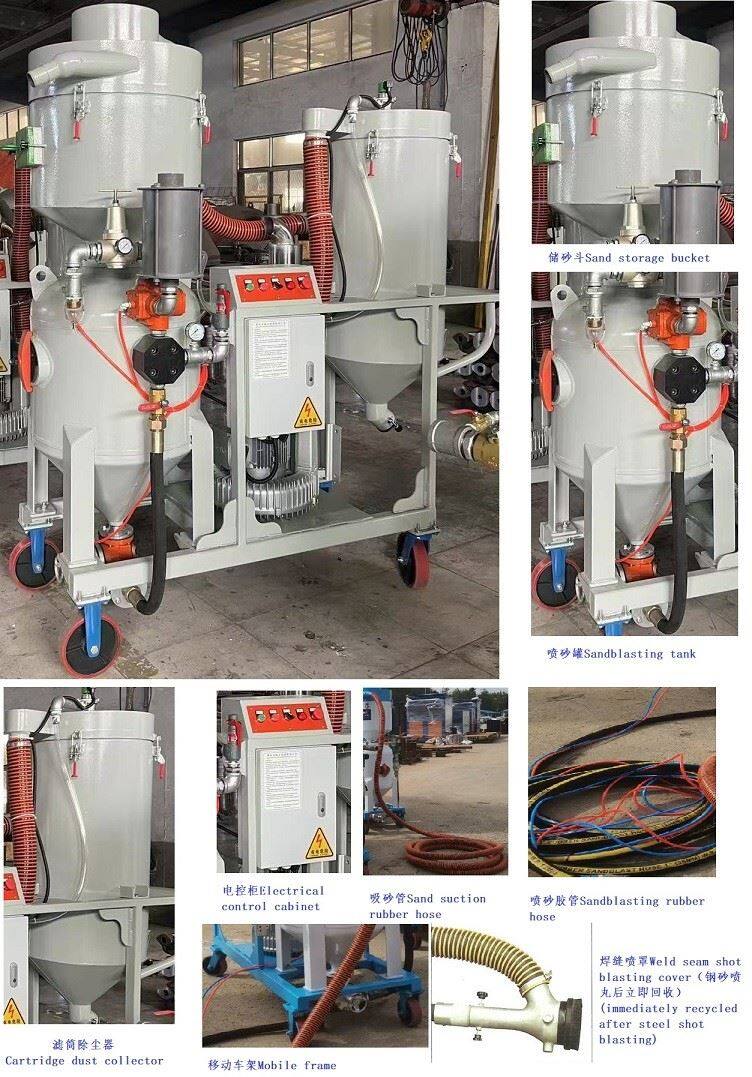
Dust-free sandblasting machine
Dust-free sandblasting machine, also known as "vacuum sandblasting machine" or "recycling sandblasting machine", is a highly efficient and environmentally friendly surface treatment equipment that integrates sandblasting and sand material recycling and circulation. Its core design concept is to complete the sandblasting operation in a closed or semi-closed system and immediately recycle the used abrasives and generated dust, thereby greatly controlling the flying of dust.
The core working principle of the dust-free sandblasting machine
The working principle of the dust-free sandblasting machine can be summarized as "simultaneous spraying and suction" or "one spraying and one suction"
Sandblasting process: Compressed air sprays abrasive materials at high speed from the spray gun onto the surface of the workpiece to complete the cleaning or roughening operation.
Recycling process: Beside or around the spray gun, there is a special "recycling hood" or "dust suction port". It uses a high-power vacuum cleaner to instantly suck in the abrasive that rebounds after hitting the workpiece, the impurities stripped off (such as rust and paint peel), and the dust into the recovery system.
Separation and circulation: The inhaled mixture passes through the separation system inside the equipment (typically using cyclone separation and filter element filtration).
Heavy materials: Reusable abrasives and heavier impurities are separated, and the abrasives will automatically return to the sandblasting tank for recycling.

Light dust: Extremely fine dust is captured by the high-efficiency dust collector placed at the back, while clean air is discharged.
This forms a nearly closed cycle, achieving the effect of "dust-free" or "low-dust".
The main features and advantages of dust-free sandblasting machines
Environmentally friendly and pollution-free: It fundamentally solves the problem of dust diffusion in traditional open sandblasting, protects the atmospheric environment and the operation site, and complies with strict environmental protection regulations.
Ensuring the health of operators: It greatly reduces the risk of operators inhaling silicon dust (the main cause of silicosis) and other harmful dust, and improves the working environment.
Abrasive recycling: Abrasives can be reused multiple times, significantly reducing the cost of abrasive consumption, especially when using expensive abrasives (such as glass beads, ceramic beads, plastic sand), the advantages are obvious.
Clean and efficient: It saves a lot of time for site cleaning. The workpieces can be taken away immediately after processing, keeping the surrounding environment clean and improving the overall work efficiency.
High flexibility: The equipment is typically designed as mobile, making it particularly suitable for on-site operations, local processing, and precision machining. For instance, it can be used to clean a certain weld seam of a large workpiece within a workshop without worrying about dust affecting other areas.
Energy conservation: Compared with traditional sandblasting rooms that require the construction of large sealed structures, its equipment investment and operational energy consumption (such as the power of dust removal fans) are usually lower.
Common Types and Applications of Dust-free sandblasting machines
Portable vacuum sandblasting machine: The most common type, equipped with a spray gun and a sand suction handle, allowing the operator to perform precise operations on the surface to be treated as if using a large "vacuum cleaner".
Application: Mold cleaning, weld seam treatment, local rust removal, stone carving, stainless steel wire drawing, glass frosting, on-site maintenance of large structural components (such as ships, Bridges, storage tanks).
Automatic recovery sandblasting chamber/cabinet: Workpieces are placed in a small sealed chamber for sandblasting. The interior is equipped with a mechanical arm or spray gun movement system, as well as a complete recovery system.
Application: Batch surface treatment of small and medium-sized precision parts, such as hardware parts, automotive components, electronic product casings, etc.
How to choose a dust-free sandblasting machine
Processing purpose: Clearly define the materials to be processed (metal, stone, glass, etc.) and processing requirements (rust removal, paint removal, roughening, and polishing).
Workpiece size and shape: For small and precision parts, a sandblasting chamber is optional. For large and immovable workpieces, portable equipment must be selected.
Abrasive type: Different equipment has different requirements for the type and particle size of abrasives. It is necessary to confirm whether the equipment supports the abrasives you plan to use (such as steel grit, glass beads, walnut sand, etc.).
Core parameters of dust-free sandblasting machine
Air compressor requirements: Check the air pressure (typically 6-8 bar) and air consumption (CFM/m³/min) required by the equipment to ensure that your air compressor can provide a stable and sufficient air source.
Suction power: The power of a vacuum cleaner determines the recovery effect. The greater the power, the higher the recovery efficiency and the better the "dust-free" effect.
Filter grade: It is best to choose a device equipped with a HEPA (High-Efficiency particulate Air) filter to ensure that the discharged air is truly clean.
Brand and After-sales Service: Choose a reputable brand from our company to ensure the quality of the equipment, reliable after-sales service and supply of spare parts.
Precautions
It is not absolutely "100% dust-free" : At the moment when the spray gun leaves the surface of the workpiece, there may be a slight escape, but compared with traditional sandblasting, the dust control effect is worlds apart.
Equipment maintenance: It is necessary to regularly clean the filters and inspect worn parts (such as nozzles and recovery pipes) to ensure that the equipment is always in the best working condition.
Personal protection: Although dust has been significantly reduced, it is still recommended to wear goggles and noise-canceling earplugs during operation to protect your eyes and hearing.
In conclusion, the dust-free sandblasting machine is an important environmental protection technological innovation in the modern surface treatment industry. It successfully combines efficient processing with employee health and environmental protection, making it an ideal alternative to the traditional highly polluting sandblasting process.


