


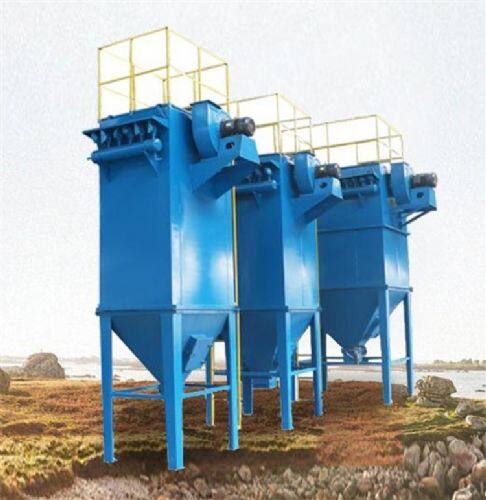
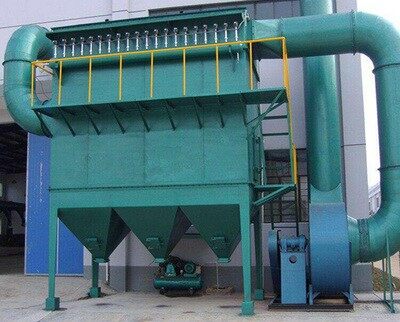
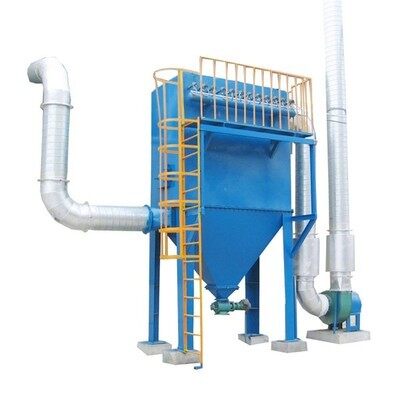
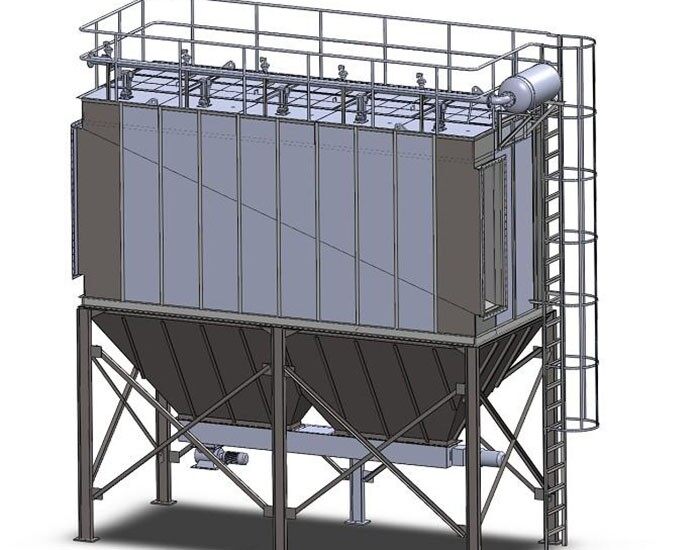
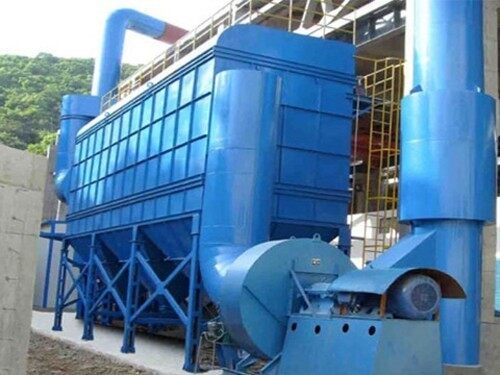
The vertical bag filter, also known as the dry filter dust collector, is a type of dry high-efficiency dust collector. It employs bag-type filter components made of fiber-woven materials to capture solid particles in dusty gas. The operational principle involves dust particles passing around the filter cloth fibers, where they collide with the fibers due to inertial force and are subsequently intercepted. Fine dust particles (with a particle size of 1 μm or less) continuously change their direction of movement due to the impact of gas molecules (Brownian motion). Since the gaps between the fibers are smaller than the free path of the Brownian motion of gas molecules, the dust particles collide with the fibers, come into contact with them, and are separated. The working process of the system is influenced by factors such as the weaving method of the filter material, fiber density, diffusion, inertia, occlusion, gravity, electrostatic effects, and the dust cleaning method.
The filter cloth material is critical to the performance of the bag filter. A well-performing filter cloth not only possesses specific density and air permeability but also exhibits excellent corrosion resistance, heat resistance, and high mechanical strength. Currently, the heat resistance of fibers can reach up to 250–350 ℃.
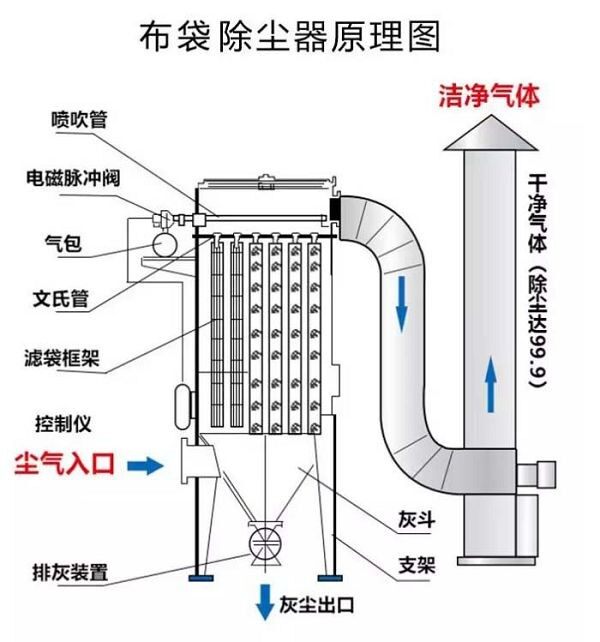
The bag-type dust collector operates using the high-pressure pulse reverse blowing method for dust cleaning. Due to its adjustable pulse jet intensity and frequency, the pulse-jet bag filter demonstrates excellent dust cleaning efficiency and is widely used globally as a dust removal device. Dusty gas enters the bag filter through the inlet and then flows into each unit chamber via guide pipes. Under the guidance of the device, large-particle dust is separated and directly falls into the ash hopper. The remaining dust is evenly distributed across the filtration areas of each chamber along with the airflow. After filtration, the clean gas is discharged through the filter bags, upper box body, lift valve, and exhaust pipe. As the filtration process progresses, when the dust on the surface of the filter bag reaches a certain thickness, the dust cleaning control device (differential pressure, timed, or manual control) closes the lifting valve according to the preset program, controls the current unit to go offline, and opens the electromagnetic pulse valve to blow and shake off the dust on the filter bag. The dust that falls into the ash hopper is discharged through the ash discharge valve and transported out by the ash conveying system.


