


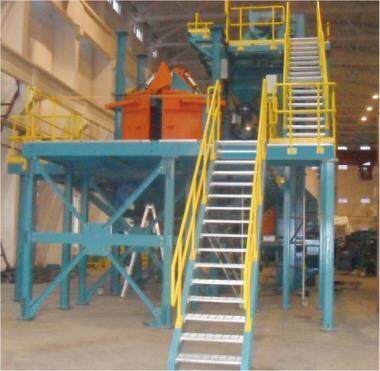
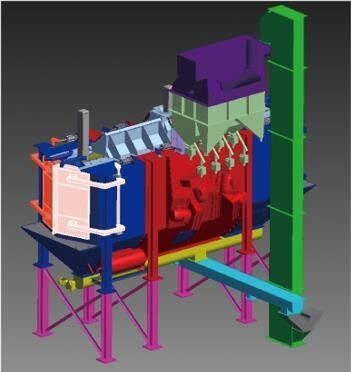
Anode shot blasting cleaning machine
China's aluminum industry has been making unremitting efforts to improve various economic and technical indicators for a long time and has made certain progress in current efficiency, power consumption and other aspects. However, due to various reasons, the consumption of anode carbon is not very satisfactory. The consumption rate of the anode carbon block in the 200kA prebaked cell of aluminum electrolysis is approximately 1.44cm/d, and the service life of the anode carbon block is generally 28 days. If it exceeds 28 days, the electrolyte will erode the anode steel claws. The eroded steel claws and phosphor iron rings will melt into the molten aluminum, not only reducing the service life of the anode steel claws but also significantly affecting the improvement of the grade of the molten aluminum. The technology of protecting the carbon ring of the anode steel claw shot blasting machine is very necessary for the product to increase the service life of the steel claw and improve the quality of electrolytic aluminum.
The steel claw shot blasting machine for electrolytic aluminum anode is increasingly widely used in the anode assembly workshop of electrolytic aluminum plants.
In the electrolytic aluminum industry, anode steel claws, as important conductive accessories, are prone to adhering to impurities that affect conductivity on the surface of the claw heads during the production turnover cycle, and they are difficult to handle. At present, domestic electrolytic aluminum manufacturers basically adopt manual grinding and shot blasting for treatment, which involves high labor intensity, low efficiency, high cleaning production operation costs and unsatisfactory results, and cannot meet the technical parameters of the production process and the requirements of large-scale production.
At present, in the aluminum industry, the steel claws for anode assembly generally have problems such as simple equipment and single methods in the process of graphite coating. In the existing graphite coating process, most of the methods adopted are compressed air blowing combined with manual stirring or dry graphite coating. The two methods have the following problems: The method of blowing and stirring with compressed air results in the inability to guarantee the concentration and uniformity of the graphite coating on the steel jaws. The graphite solution contains a large amount of water, resulting in poor graphite coating effect, easy graphite sedimentation, and even blockage of the compressed air pipeline. The inability to guarantee the concentration and uniformity of the graphite coating, the moisture contained in the compressed air causes the molten iron to splash during casting, affecting the casting quality and posing a high risk. The unit consumption of compressed air has increased.
Technical implementation elements
In response to the above technical issues, the anode steel claw shot blasting machine provides an electrolytic aluminum anode steel claw cleaning device with low cleaning cost, good cleaning efficiency and avoiding air pollution, in order to overcome the deficiencies in the existing technology.
The anode claw and anode rod throwing force cleaning machine is a dedicated device for cleaning the surface of anode claws and anode rods. Through throwing force cleaning, it removes the residual electrolyte and floating carbon on the anode surface, improves the conductivity, and also cleans the part of the steel claw head below the steel claw crossbeam.
When the steel claw shot blasting machine is in operation, the guide rod group is sent into the shot blasting cleaning position inside the machine by the suspension chain. After being in place, the rotating track on the suspension chain drives the guide rod group to rotate and the shot blasting machine opens. The shot blasting machine sprites the steel shot at high speed onto the surface of the steel claws, and then the blowing device blows away the steel shot and other impurities on the surface of the steel claws. The steel shot and electrolytes and other impurities after ejector fall into the lower screw conveyor. The screw conveyor sends them into the bucket elevator, which then conveys them to the separation device. The separation device separates the steel shot and electrolytes through air selection and screening. The separated steel shot enters the storage bin for recycling, while the electrolytes and other impurities are discharged from the equipment.


